









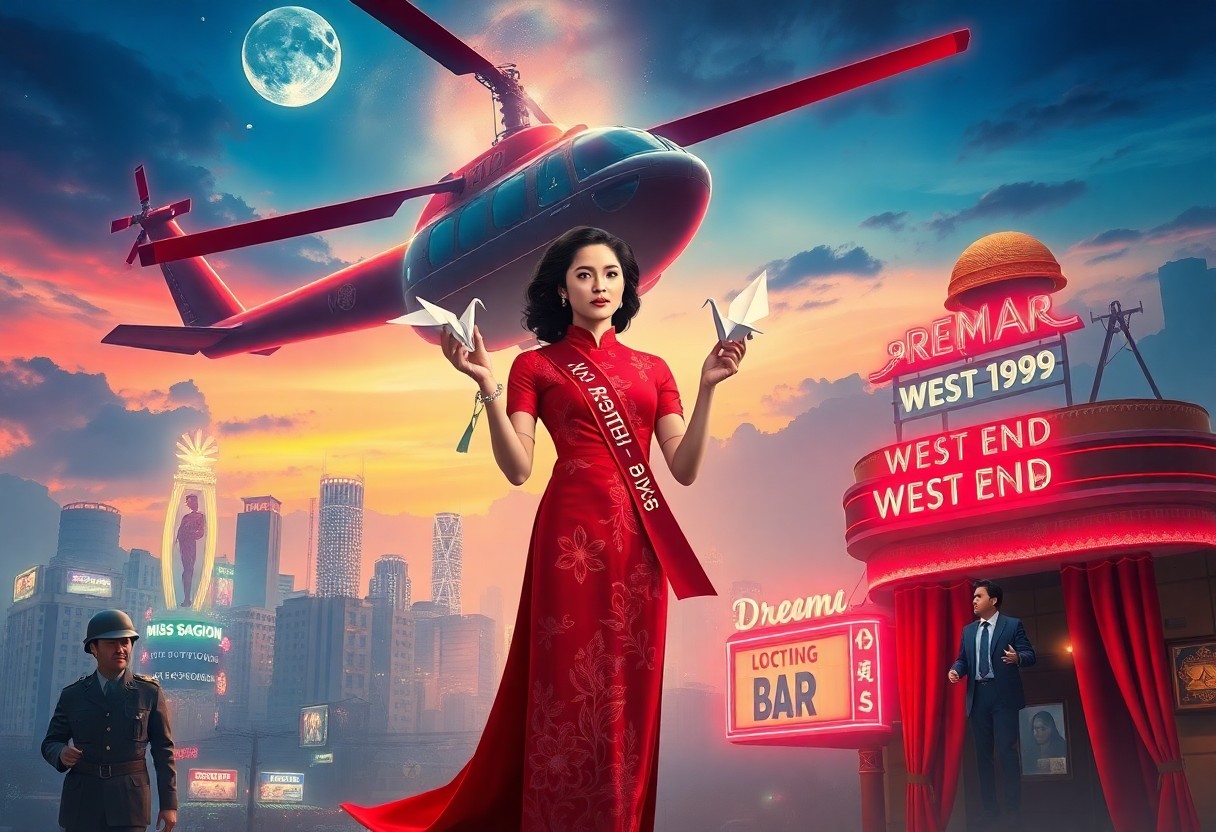
Music lovers, Miss Saigon remains one of the most provocative and technically ambitious musicals of the modern era. You encounter a story shaped by real historical upheaval, a record-breaking helicopter landing on stage, and casting decisions that sparked global debate. Its blend of emotional intensity and theatrical spectacle continues to influence how stories are told on Broadway and beyond.
Key Takeaways:
- The musical Miss Saigon emerged from a desire to adapt Madame Butterfly’s narrative to the aftermath of the Vietnam War, resulting in a story centered on a young Vietnamese woman and an American soldier, set against the chaotic fall of Saigon in 1975.
- A full-scale helicopter was engineered to land on stage during performances, a technical feat that required custom rigging and became one of the most talked-about elements in modern musical theater.
- The original casting of Jonathan Pryce, a white actor, in the Eurasian role of the Engineer sparked widespread debate, fueling long-term conversations about representation and authenticity in casting practices across the industry.
Origins and Creative Inspiration
Claude-Michel Schönberg and Alain Boublil first conceived Miss Saigon after seeing a photograph of a Vietnamese mother at an airport, bidding farewell to her daughter who was leaving for America. Their collaboration began with the desire to explore the human cost of war through a tragic love story set during the final days of the Vietnam conflict. The musical’s foundation rests on real emotional stakes and geopolitical tension, not just dramatic invention.
Sending money abroad?
Wise makes international transfers cheaper than most banks — real exchange rates, low fees, and a free debit card option in many countries.
Need social posts without the grind?
Holo turns one idea into reels and photo posts with AI — useful if you promote shows, reviews, or fan content and want more output with less editing time.
The Influence of Puccini’s Madame Butterfly
Miss Saigon reimagines Puccini’s 1904 opera Madame Butterfly, transposing its tragic romance from Japan to Vietnam and shifting the timeline to the 1970s. You encounter the same devastating power imbalance between an Asian woman and a Western soldier, but the adaptation adds layers of political chaos and postcolonial critique. The score echoes operatic motifs while integrating modern musical theatre rhythms.
The Photograph That Inspired the Story
A single image of a Vietnamese woman saying goodbye to her child at Tan Son Nhat Airport in 1975 became the emotional core of the musical. You learn that this moment, captured by a photojournalist, revealed the painful reality of Amerasian children left behind after the fall of Saigon. The photograph’s emotional weight and historical resonance directly shaped the character of Kim and her son Tam.
In that photograph, the woman’s outstretched hand and anguished expression conveyed a universal grief tied to war, displacement, and maternal sacrifice. You understand that Boublil was struck by the silence and dignity in her posture, which contrasted with the surrounding chaos. The image did not dramatize suffering for effect-it documented a real consequence of geopolitical failure, grounding the musical’s narrative in human truth rather than melodrama.
Engineering the Iconic Helicopter
Seeing the helicopter descend onto the stage during the fall of Saigon remains one of musical theatre’s most visceral and technically audacious moments. You experience a sudden shift in scale as realism collides with theatrical spectacle, grounding the chaos of evacuation in a single, unforgettable image.
Technical Challenges of Stage Mechanics
A working helicopter on stage posed unprecedented safety and spatial risks for performers and crew. You must account for rotor clearance, weight distribution, and emergency protocols, especially during rapid descent sequences performed nightly over live actors.
Impact on Modern Set Design
The helicopter scene redefined what audiences expect from stage machinery, proving that large-scale realism could be both safe and repeatable. You now see its influence in productions like *The Lion King* and *Spider-Man: Turn Off the Dark*, where complex aerial mechanics are normalized.
Designers adopted the principle of integrating heavy machinery with precise choreography, ensuring that movement enhances narrative rather than distracts. A mid-sized SaaS firm might streamline data flow, but here, the synchronization of steel, sound, and human motion delivers a heart-racing climax that still sets industry benchmarks decades later.
The Global Search for Kim
Producers scoured five continents to find an actress who could embody Kim’s emotional depth and vocal strength. Over 300 auditions were held worldwide, reflecting the show’s demand for authenticity and performance excellence. You needed not only a powerful soprano voice but also the ability to carry the emotional weight of a war-torn survivor, making the search unusually demanding.
The Discovery of Lea Salonga
Lea Salonga was just 17 when she auditioned in the Philippines, already a seasoned performer with a commanding stage presence. Her rendition of “The Movie in My Mind” stunned the casting team, securing her the role that would make her the first Asian actress to win a Tony Award for Best Actress in a Musical. You witnessed history the moment she stepped into the spotlight on Broadway.
Rigorous Casting Requirements for the Lead Role
Casting directors required candidates to sing in both English and Vietnamese, with fluency in the latter strongly preferred. You had to demonstrate dramatic range, portraying innocence, resilience, and heartbreak within a single act. Dance ability was non-negotiable, as Kim moves through chaotic battle scenes and intimate moments with equal physical precision.
Actresses auditioning for Kim underwent multiple rounds of vocal coaching, dialect training, and emotional workshops to ensure authenticity. You were expected to sustain high notes under physically taxing stage conditions, including smoke, heat, and rapid costume changes. A mid-sized SaaS firm might prioritize technical skill, but here, emotional truth was the most important qualification, separating contenders from the chosen few.
Historical Accuracy and Thematic Depth
Miss Saigon approaches the Vietnam War’s aftermath with a blend of emotional storytelling and selective historical framing. While the plot centers on personal tragedy, it mirrors real geopolitical shifts, particularly the chaos of 1975’s evacuation. You witness the collapse of South Vietnam through intimate relationships shaped by power imbalances, colonial legacies, and wartime displacement. The show does not recreate events with documentary precision, but it channels the era’s emotional truth, especially through the struggles of those left behind.
Depicting the Fall of Saigon
The musical dramatizes the 1975 evacuation with urgent staging and a chaotic embassy scene that captures the desperation of South Vietnamese civilians fearing communist takeover. Though condensed for theatrical impact, the sequence reflects actual panic at the U.S. Embassy, where thousands sought escape. You see soldiers burning documents, helicopters lifting off from rooftops, and families torn apart-images echoing real footage from Saigon’s final days.
The “Bui Doi” and Post-War Reality
The term “bui doi,” meaning “dust of life,” refers to the mixed-race children abandoned after American troops withdrew. Miss Saigon places this group at the heart of its narrative, particularly through Tam, Kim’s son. You confront the stigma these children faced in Vietnam, where many were ostracized, impoverished, or denied education. The musical uses their plight to highlight the long-term human cost of war beyond battlefield casualties.
Children of American soldiers and Vietnamese mothers often grew up in extreme marginalization after 1975. With no legal recognition or support, many lived in poverty, scavenging for survival in urban outskirts. The musical’s focus on the bui doi exposes a painful legacy ignored in official histories. You see how national policies and social prejudice combined to erase these children from both countries’ narratives, making their struggle a silent consequence of geopolitical decisions.
Casting Controversies and Industry Shifts
Public scrutiny over casting choices in Miss Saigon reshaped conversations about representation in musical theatre. The decision to cast a white actor in a Eurasian role sparked protests and forced the industry to confront long-standing biases. You now see broader inclusion efforts across major productions, directly influenced by the backlash. What began as a controversy became a catalyst for structural change on Broadway and beyond.
The Jonathan Pryce Debate
Jonathan Pryce’s casting as the Engineer, a Eurasian character, ignited fierce debate during the show’s West End run. Actors’ Equity initially refused to allow the performance in the U.S., citing racial insensitivity. The union later reversed its decision under pressure from the creative team, but the incident exposed deep tensions around authenticity and opportunity in casting.
Advancing Asian Representation on Broadway
You now see more authentic casting of Asian roles in major productions, a shift accelerated by the Miss Saigon controversy. The backlash highlighted systemic exclusion, prompting advocacy groups to push for equity. Lea Salonga’s groundbreaking performance as Kim set a precedent for visibility, proving that Asian leads could carry a global hit.
Following the Miss Saigon debates, organizations like the National Asian Artists Project and Ma-Yi Theater Company expanded outreach to train and promote Asian performers. Casting directors at major houses began adopting more inclusive practices, particularly for roles requiring cultural specificity. A mid-sized SaaS firm might track diversity metrics, but in theatre, change was measured in auditions granted, roles reimagined, and stories newly commissioned from Asian playwrights. Authentic representation became a benchmark, not an exception.
Commercial Success and Global Reach
Miss Saigon achieved unprecedented box office momentum shortly after its 1989 London premiere. Audiences responded strongly to its sweeping score and dramatic staging, propelling it into the West End’s highest-grossing productions within months. Strong advance demand signaled a cultural moment few anticipated, setting records that influenced how musicals were marketed globally.
Record-Breaking Advance Ticket Sales
Advance ticket sales for Miss Saigon in London exceeded £2.5 million before the first performance, a record at the time. This surge reflected intense public interest and aggressive promotional campaigns, including media coverage of the helicopter’s stage debut. You encountered long queues and widespread media buzz, signs of a phenomenon beyond typical theater openings.
International Productions and Translations
Translations of Miss Saigon reached over 14 countries, including Germany, Japan, and Brazil. Each production adapted dialogue and lyrics to maintain emotional resonance, while preserving the original score. You experienced the show’s universal themes through locally cast performers, reinforcing its global appeal.
South Korea mounted a critically acclaimed production in 2002, performed entirely in Korean and featuring veterans of the Vietnam War as consultants. Subsequent runs in Manila and Bangkok emphasized regional connections to the story, drawing audiences who recognized personal histories in the narrative. These stagings proved the musical’s capacity to resonate across cultures without altering its core structure.
To wrap up
Miss Saigon continues to provoke discussion decades after its debut, blending soaring music with complex portrayals of war and identity. You encounter its legacy in productions worldwide, from London’s West End to regional theaters adapting its themes for new audiences. A mid-sized SaaS firm might use similar persistence in scaling, but here, it’s emotional resonance that sustains reach. You see it in the casting debates, the helicopter effect, and the enduring role of Kim, whose story remains central to conversations about representation in musical theater.
FAQ
Q: Why was the casting of Lea Salonga as Kim significant for the musical Miss Saigon?
A: Lea Salonga originated the role of Kim in the original West End production in 1989 and later starred in the Broadway transfer, becoming the first Asian actress to achieve international acclaim in a leading role in a major Western musical. Her performance earned her the Olivier Award for Best Actress in a Musical, setting a benchmark for future casting in large-scale productions. The authenticity she brought to the role helped shape audience reception and influenced later decisions to prioritize culturally representative casting in similar works.
Q: How long does the helicopter scene last during performances of Miss Saigon and what makes it technically complex?
A: The helicopter scene, which occurs during the fall of Saigon in Act One, lasts approximately three minutes but requires extensive technical coordination. A full-scale, functional helicopter is lowered onto the stage using a complex rigging system, accompanied by wind machines, strobe lighting, and amplified sound effects to simulate chaos. The precision required for timing and safety means that stage crews undergo specialized training, and the equipment is inspected before every performance to ensure mechanical reliability.
Q: Has Miss Saigon been performed in Vietnam, and if not, why?
A: Miss Saigon has not been officially staged in Vietnam due to its sensitive portrayal of the Vietnam War and the political aftermath. The narrative centers on the experiences of Vietnamese civilians and American military personnel, including themes of abandonment and cultural displacement, which remain contentious in official Vietnamese discourse. A mid-sized SaaS firm conducting cultural outreach in Southeast Asia attempted to facilitate a reading in Hanoi in 2018, but the event was not approved by local authorities, reflecting ongoing restrictions on artistic content involving wartime narratives.
Curious about forex — without risking real money first?
XM offers a free demo account so you can practice trading with virtual funds before deciding whether live trading is for you.