
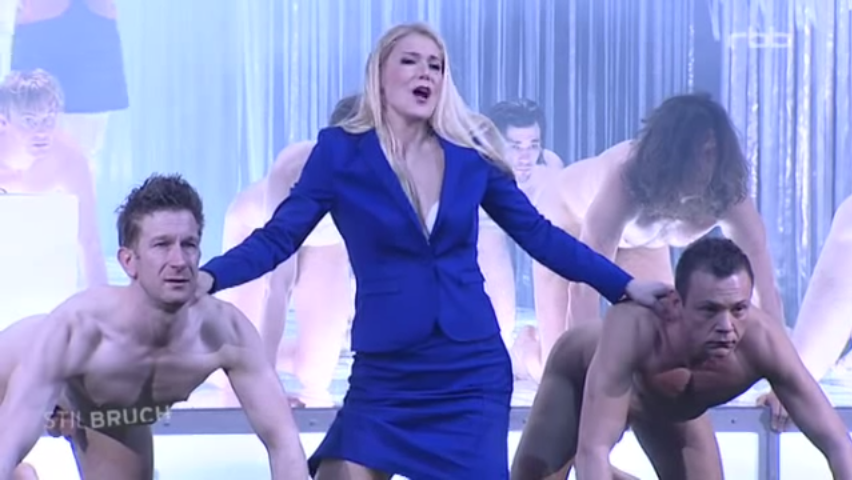
Calixto Bieito naked operas are productions by the Catalan-based Spanish director in which nudity works as dramatic commentary: it exposes power, vulnerability and hypocrisy rather than simply shocking the audience. His stagings of Berg’s Lulu and Rossini’s Armida are the best-known examples, and they explain why he is both one of Europe’s most sought-after opera directors and one of its most argued-about.
This guide explains who Bieito is, what his nudity is meant to say, why purists and modern audiences react so differently, and what American houses have actually staged of his work.
As an Amazon Associate, Musicals On Line may earn a commission from qualifying purchases at no extra cost to you.

Who is Calixto Bieito?
Calixto Bieito is a Spanish theatre and opera director who built his career in Catalonia and then across German-speaking houses. San Francisco Opera’s program essay notes that he first gained international notoriety with his 2004 production of Mozart’s Die Entführung aus dem Serail at Berlin’s Komische Oper, a sold-out staging that made him “loved and hated” for his contemporary visions of cruelty and sexuality (San Francisco Opera). Some critics have nicknamed him the “bad boy of opera.”
Bieito has linked his dark humor to the Spanish literary tradition of Cervantes and his sense of distorted, dreamlike imagery to the films of Luis Buñuel. He has also spoken about a Jesuit education that taught him how powerful images of guilt and fear can be. Put together, those influences explain his method: he takes a familiar opera, removes the comfortable costume-drama surface, and forces the audience to look at what the story is really about.
Not everyone likes the result. But the goal is consistent. Disturbing an audience, in Bieito’s view, is a way of making it think.
Why do Calixto Bieito naked operas use nudity?
In Bieito’s work, a body on stage is rarely just a body. It is a statement about who holds power in the scene, who is being looked at, and who is doing the looking. Clothing can signal status, respectability or hypocrisy; its absence can signal exposure, exploitation or the moment a character’s mask finally falls away.
That is why the same choice can mean very different things from one production to the next. In one opera it can show a character’s only weapon. In another it can show how a powerful woman sees the men around her. The nudity is a directorial language, and the question for the viewer is always: what is this image saying about the characters?
It also helps to remember the context. Nudity on stage is far less rare in contemporary European theatre than it was a generation ago. What still surprises some opera fans, especially those who love the bel canto era, when the music and the voice were the whole show, is seeing that language applied to repertoire they think of as purely musical.
What does nudity mean in Bieito’s Lulu?
Alban Berg’s Lulu is an opera that is already about desire, manipulation and murder, so a frank staging is not a surprise. Bieito’s version for Theater Basel became one of his more widely discussed productions.
The title character is amoral and magnetic. Men ruin themselves around her, and she survives, for a while, on the one power society allows her: her allure. In Bieito’s reading, her exposure on stage underlines that this is the only currency she has. The point is not titillation. It is the bleak recognition that Lulu is valued only for her body.
That is why the final image matters. By the end of the opera, Lulu has nothing left to offer and nothing left to hide. Showing her completely exposed at the close becomes Bieito’s comment on the character: the charm that controlled every man around her has worn off, even when nothing is hidden. The image is meant to feel cold and sad, not seductive.


How does Bieito’s Armida turn nudity into social criticism?
Rossini’s Armida is a fantasy opera about a sorceress who enchants the crusader knight Rinaldo. Bieito strips out the fantasy. Instead of magic gardens, he presents Armida as a liberated, headstrong woman surrounded by men, and he uses the contrast between bare and clothed bodies to make his argument.
Armida is surrounded by unclothed men, yet the man she wants is the fully clothed Rinaldo. The visual contrast is a comment on how “honorable men” are seen and on how a powerful woman looks at the men around her. Much of the nudity in this staging reflects Armida’s gaze, not the audience’s. Which character is objectifying whom becomes the real question of the evening.
This was especially provocative because Rossini’s operas were written in an era focused on vocal display; nobody expects a bel canto score to carry this kind of staging. Bieito brought Armida to Berlin’s Komische Oper, a company known for performing opera in German translation. For purists, translation alone is a step too far. Add Bieito’s concept and the reaction was bound to be loud.


How do purists and modern audiences react to his productions?
Reactions split along a familiar line. Traditionalists argue that opera should serve the composer and the score, and that a concept staging pulls attention away from the music. They see nudity as a distraction or a box-office stunt.
Supporters argue the opposite: that a centuries-old work only stays alive if each generation finds what it means now. For them, Bieito’s stagings make old stories feel dangerous again. Bieito himself has acknowledged that his radical approach has critics, but he has consistently put expression ahead of rules. Audiences at the Komische Oper, in particular, embraced his Armida, and it remains one of his signature productions.
If you want to see this debate in a wider frame, our piece on how modern is tolerable in opera looks at where audiences draw the line.
Have the Met or San Francisco Opera staged Calixto Bieito’s work?
This is where older coverage, including the first version of this article, needs updating.
In 2015 the New York Times reported that the Metropolitan Opera had engaged Bieito for a new production of Verdi’s La Forza del Destino, planned for the 2017-18 season. That production never reached the Met stage. In January 2017 the Met canceled it as a cost-cutting measure and replaced it with concert performances of Verdi’s Requiem, postponing Bieito’s Met debut indefinitely (New York Times, 2017). When Forza finally returned to the Met in 2024, it was in a different production by Mariusz Treliński.
San Francisco Opera did stage him. As the New York Times reported when the season was announced, SFO programmed Bieito’s Carmen for its 2015-16 season. It played from May 27 to July 3, 2016, as a co-production with Boston Lyric Opera based on Bieito’s staging from the Peralada Festival and Opera Zuid, revived by his longtime collaborator Joan Anton Rechi (SFO Performance Archive). It was Bieito’s United States opera debut.
That Carmen moves the story to post-Franco Spain. According to Rechi, its few scenes of nudity are there for a reason: the naked toreador at the start of Act III refers to the “moon baptism” ritual that superstitious bullfighters perform the night before a fight. Bieito’s Carmen has also been staged in English at English National Opera.
Is Calixto Bieito’s nudity gratuitous?
That is ultimately for each viewer to decide, but the pattern across his work is clear. The nudity usually lines up with the opera’s own themes: Lulu’s commodified allure, Armida’s gaze, the bullfighter’s ritual in Carmen. You may find a particular choice heavy-handed, but it is rarely random.
A useful way to judge any of these productions is to ask three questions. Does the image reveal something about a character’s power or vulnerability? Does it connect to what the music is doing at that moment? And would the scene lose meaning without it? Bieito’s best work passes those tests, which is why his productions keep being programmed despite the controversy.
For comparison, see how two other productions handled the same question in our articles on Salome and nudity in opera and what worked in Les Contes d’Hoffmann. For the bigger picture, our guide to operas with nudity walks through six famous productions, from Maria Ewing’s Salome to the booed Guillaume Tell.
Listen and play along
See Bieito’s Carmen for yourself on the Gran Teatre del Liceu Carmen DVD (affiliate link) with Béatrice Uria-Monzon and Roberto Alagna. The same filming is also on Blu-ray (affiliate link).
Stream full opera recordings free with an Amazon Music Unlimited trial.
As an Amazon Associate I earn from qualifying purchases.
Frequently asked questions
Who is Calixto Bieito?
He is a Spanish theatre and opera director, based in Catalonia, known for provocative, contemporary stagings of classic operas across Europe.
Which Calixto Bieito operas include nudity?
His productions of Berg’s Lulu and Rossini’s Armida are among the most discussed. His Carmen also includes a few scenes of nudity tied to the drama.
Did Calixto Bieito direct at the Metropolitan Opera?
No. His planned 2017-18 Met La Forza del Destino was canceled in January 2017 for budget reasons, so his Met debut was postponed indefinitely.
When did Bieito’s Carmen play in San Francisco?
San Francisco Opera staged it from May 27 to July 3, 2016. It was his US opera debut.
Why does Bieito use nudity in opera?
He uses it as commentary on power, desire and hypocrisy. It is meant to make the audience think about the characters, not to shock for its own sake.
Modern opera will keep ruffling purists’ feathers, and productions like Bieito’s will keep fueling the debate. Like our official Facebook page, Musicals Online, and follow us on Twitter @musicalsnews. Thanks for reading.