
Raoul buys the monkey music box in The Phantom of the Opera because Christine had described it to him, and when he sees it at the opera house auction, it is exactly as she said: his last link to her and to the Phantom. The box plays “Masquerade” and frames the whole musical as an old man’s memory, which is why the story opens and closes with it.
We first wrote about the monkey music box after watching The Phantom of the Opera and asking what that little monkey has to do with the story. This updated version separates what the show actually tells us from our own fan theories. The screenshots are from the 25th anniversary staging at the Royal Albert Hall.
- The Phantom of the Opera, Original 1986 London Cast Recording (2 CDs)
- The Phantom of the Opera piano/vocal selections (Hal Leonard)
Why does Raoul buy the monkey music box?
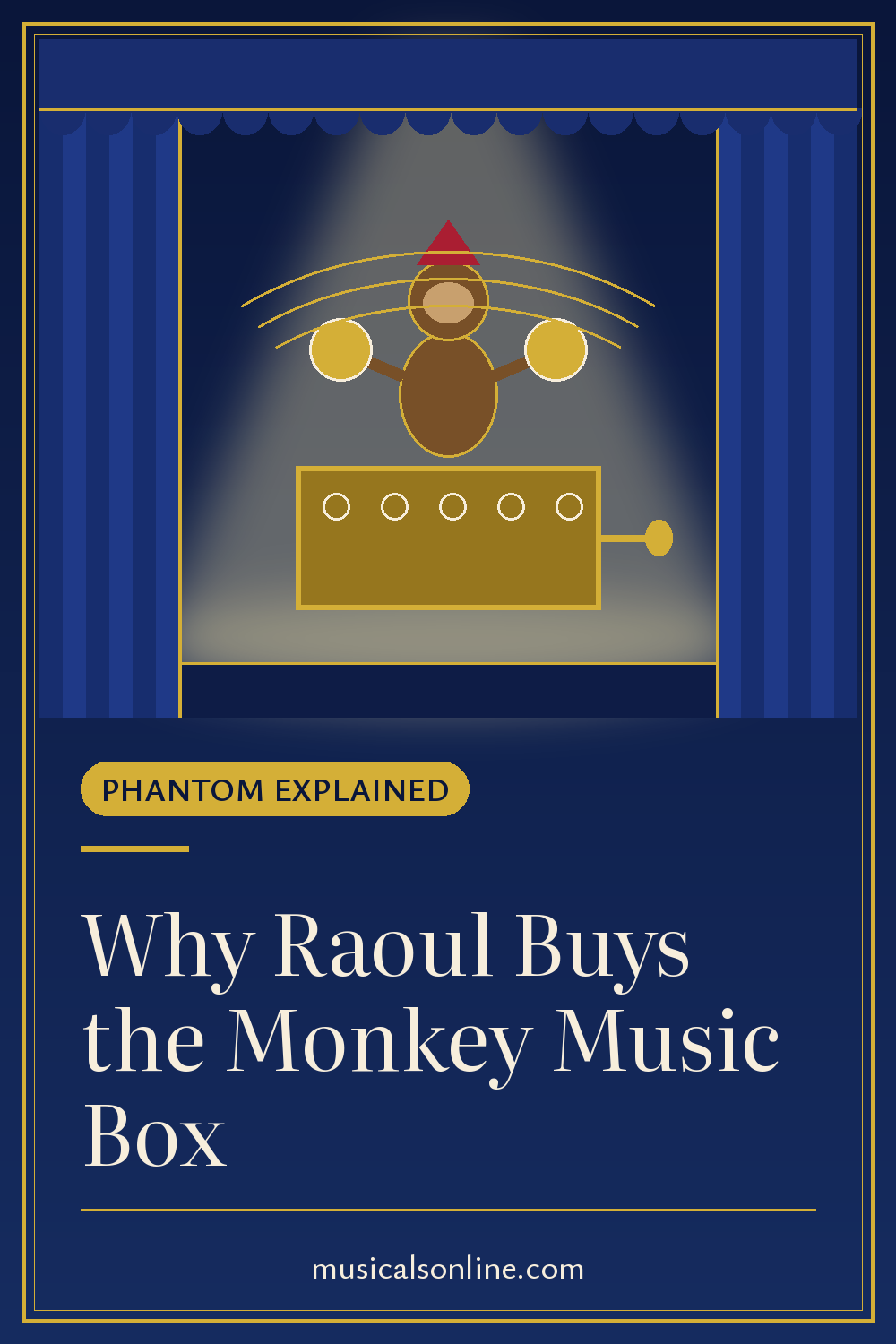
The musical opens years after the main story, at an auction of old props and fittings from the Paris Opéra. Raoul, now an elderly Vicomte de Chagny, is in the audience. When the auctioneer offers lot 665, a papier-mâché music box in the shape of a barrel organ with a monkey in Persian robes playing cymbals, found in the opera house’s vaults and still in working order, Raoul bids for it and wins.

As he looks at it, he remarks to himself that it’s a collector’s piece and that every detail is “exactly as she said”. Christine had told him about the box, which she saw in the Phantom’s lair. For Raoul, buying it is a way to hold on to a piece of her past, and of the man who shaped it. He then wonders aloud whether the box will keep playing after all of them are gone. It’s a quiet, sad moment, and it tells us right away that the story we’re about to see is a memory.

Different productions and recordings set the auction in different years in the early 20th century, so we won’t pin it to one date. Joel Schumacher’s 2004 film sets it in 1919.
What is the significance of the monkey in The Phantom of the Opera?
The show never explains the monkey in words, so its meaning comes from where it is used:
- It belongs to the Phantom. The box is one of the few personal possessions we see in his lair. A toy that plays music fits a man who has lived for music and has had almost nothing else.
- It is a frame. The box links the opening, Raoul’s memory, to the final scene in the lair. When the music box plays, we’re inside the story; when it stops, we’re back in the auction room.
- It is a symbol of being trapped and put on show. A costumed monkey that performs on command is a pointed image for a man who is himself hidden, costumed and turned into a spectacle. The 2004 film makes this link explicit (see below).
For more about the characters involved, see our Phantom of the Opera character descriptions.
What song does the monkey music box play?
The box plays “Masquerade”, the waltz that opens Act Two at the New Year’s ball (you can hear the full number on the original London cast recording). The choice fits: “Masquerade” is a song about hidden faces, and the Phantom is the ultimate masked man. Right after the music box falls silent, the auctioneer moves on to the next lot, the restored chandelier. As it rises, the overture crashes in and we’re thrown back into the opera house’s glory days. To see where both numbers fall in the score, read our Phantom of the Opera songs explained guide.

Want to play the “Masquerade” waltz or other Phantom show tunes on piano yourself? Pianoforall is a beginner-friendly course that teaches piano by ear using chords. Try Pianoforall.
Disclosure: this is an affiliate link. Musicals On Line may earn a commission if you buy, at no extra cost to you.
Where does the music box come from in the Phantom’s backstory?
On stage, it comes from nowhere we’re told about. The musical gives the Phantom very little backstory: Madame Giry briefly tells Raoul about a deformed man who escaped from a travelling fair, and the box is simply one of his things.
The 2004 film expands that. Madame Giry tells Raoul in a flashback that, as a girl, she saw the Phantom as an abused child kept in a cage and displayed in a freak show, and helped him escape. Many fans connect that image to the caged, costumed, performing monkey, though the film doesn’t say so outright. It’s a reading, not a stated fact.
The box is not in Gaston Leroux’s original 1910 novel. There’s no auction prologue and no monkey music box in Leroux’s book (The Phantom of the Opera, Project Gutenberg). It’s an invention of the 1986 musical.
What happens to the music box at the end of the stage show vs the 2004 film?
On stage: after the Phantom lets Christine and Raoul go, he is left alone in his lair. The music box plays “Masquerade” and he sings softly along with it. Christine returns briefly to give back his ring, then leaves for good. When the mob and Meg Giry break in, the Phantom has vanished, leaving only his mask behind. The box, we can assume, stays in the vaults beneath the opera house, which is where the auctioneer says it was found decades later.
In the 2004 film: the Phantom is comforted by the music box in his lair before he disappears. In the black-and-white 1919 framing scenes, the old Raoul outbids the elderly Madame Giry for it, then takes it to Christine’s grave and places it there. Beside the headstone he finds a fresh rose tied with a black ribbon and the ring Christine had given back to the Phantom, a sign that the Phantom is still alive and still loves her.

The 25th anniversary staging, filmed at the Royal Albert Hall in 2011 and the source of our screenshots, keeps the original stage version of both the auction and the ending. For current productions and official recordings, see the show’s official website.
Does Love Never Dies explain the music box?
Not as far as we can verify. Andrew Lloyd Webber’s 2010 sequel moves the story to Coney Island ten years later, and we haven’t found a reliable source showing that it explains the monkey box. Any link between the two shows is fan speculation. For how the sequel changes the characters, see Phantom of the Opera vs. Love Never Dies.
What do fans think the music box really means?
Fan theory (ours, not canon): when we first wrote this post, we suggested the box was the Phantom’s one happy memory from his life before the opera house, maybe linked to his mother, and that it balances the darker keepsakes in his lair, like the mannequin in a wedding dress that makes Christine faint. We also wondered whether Raoul buying the box is his way of accepting that, however long he and Christine were married, the Phantom was always part of their story. None of this is stated in the show; it’s simply one way to read the old man’s sad question at the auction. For more theories, trivia and guides, visit our Phantom of the Opera complete fan guide. And if you’re shopping for a Phantom fan, our gift guide for musical theatre fans has present ideas.
Frequently asked questions
Why did Raoul buy the monkey music box?
Because Christine had described it to him, and at the auction he recognizes it as exactly what she told him about. It’s a keepsake of her and of the Phantom’s world, bought by a man who is now old and alone.
What does the monkey music box mean?
The show leaves it open. Most readings see it as the Phantom’s treasured possession, a frame for Raoul’s memory, and a symbol of a performer trapped on display, a link the 2004 film strengthens with its freak-show flashback.
What tune does the music box play?
“Masquerade”, the waltz that opens Act Two. It plays at the auction in the Prologue and again in the final scene in the Phantom’s lair.
Is the monkey music box in Gaston Leroux’s novel?
No. The auction prologue and the monkey music box were created for the 1986 Andrew Lloyd Webber musical and don’t appear in Leroux’s 1910 novel.
Where is the music box at the end of the movie?
In the 2004 film, the old Raoul buys it at the 1919 auction and leaves it at Christine’s grave. There he finds a rose with her ring tied to it, left by the Phantom.