You step into a world transformed when the lights dim and the junkyard set comes alive, because Cats redefined musical theatre with its bold fusion of poetry, dance, and avant-garde staging. Based on T.S. Eliot’s whimsical verses and brought to life by Andrew Lloyd Webber’s inventive score, the musical emerged as a groundbreaking spectacle that captivated audiences from its 1981 London premiere.
Correction (October 26, 2026): We corrected this article. Trevor Nunn directed Cats, with choreography by Gillian Lynne. Les Misérables isn’t by Andrew Lloyd Webber. The songs were first heard as a song cycle at the 1980 Sydmonton Festival, not written for a TV special. We also removed several details we couldn’t verify and some stray, unrelated sentences.
Key Takeaways:
- The musical originated from T.S. Eliot’s 1939 poetry collection *Old Possum’s Book of Practical Cats*, which offered whimsical, character-driven verses rather than a traditional narrative, challenging the creators to build a story from fragmented literary sketches.
- Andrew Lloyd Webber began setting Eliot’s poems to music in 1977 and first presented them as a song cycle at his Sydmonton Festival in 1980. The full musical opened at London’s New London Theatre in 1981.
- Directed by Trevor Nunn and choreographed by Gillian Lynne, the show redefined stage movement with its feline-inspired physicality, requiring performers to embody cat-like gestures and postures, a stylistic choice that became a defining feature of its long-running success.
T.S. Eliot and the Literary Source Material
T.S. Eliot’s Old Possum’s Book of Practical Cats began as a series of whimsical poems exchanged in letters with friends and family. Published in 1939, the collection reveals Eliot’s playful side, contrasting sharply with his more austere modernist works. You encounter feline characters defined by distinct personalities and eccentric names, forming the narrative backbone of the musical. The poems’ rhythmic inventiveness and dry wit provided fertile ground for adaptation.
Adapting Old Possum’s Book of Practical Cats
Eliot’s original poems lacked a traditional plot, presenting you with a patchwork of feline vignettes rather than a linear story. Andrew Lloyd Webber saw theatrical potential in their rhythmic cadence and idiosyncratic voices. He turned standalone verses into character-driven numbers, stitching them into a loose narrative framework centered on the Jellicle Ball. The adaptation preserves Eliot’s language while expanding its emotional range through music.
Valerie Eliot and the unpublished poems
The poet’s widow and literary executor, Valerie Eliot, was central to the project. Producer Cameron Mackintosh felt the show needed a “pedigree” director to win her approval, which is one reason Trevor Nunn was brought in (Wikipedia). Our video of Trevor Nunn on directing Cats has his side of the story.
She attended the 1980 Sydmonton concert and brought along unpublished cat poems by Eliot. One of them, “Grizabella the Glamour Cat”, had been left out of the book as too sad for children, and it gave Lloyd Webber the idea for a full musical. Valerie Eliot later used part of her Cats royalties to set up the Old Possum’s Practical Trust and the T. S. Eliot Prize (Wikipedia).
Andrew Lloyd Webber’s Compositional Journey
Lloyd Webber had written several musicals before Cats reached the West End, but it was T.S. Eliot’s poetry that inspired a new creative path. What started as a private fascination with whimsical verse evolved into a groundbreaking theatrical experiment, merging narrative fragmentation with melodic innovation. The score became a character in itself, guiding audiences through a moonlit world of feline personas with emotional precision and theatrical flair.
Evolving from a song cycle to a stage musical
A single song, “Memory,” became the emotional anchor that transformed a collection of vignettes into a cohesive narrative. Grizabella’s arc gave the show its structure. For a performance of the song, see our Memory sing-along. This pivot from disconnected numbers to a through-line of longing and redemption gave the production its theatrical spine and emotional depth.
Integrating electronic and classical influences
Synthesizers and the pit orchestra coexist in Cats. Lloyd Webber used analog synthesizers in the overture and “The Jellicle Ball” to create an electronic soundscape that was unusual for a 1981 stage musical. The original London cast recording captures that sound.
The Revolution of Immersive Stage Design
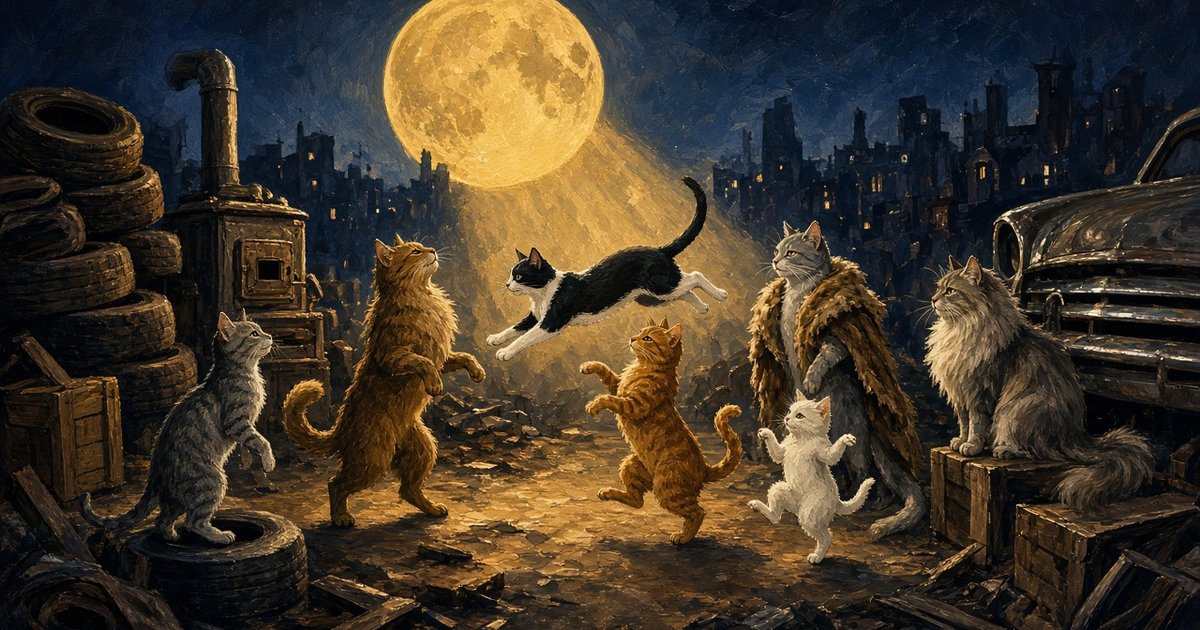
John Napier’s junkyard set changed how the stage was used. Nunn and Napier wanted “an environment rather than a set”, and the New London Theatre was configured almost in the round, with a central revolving stage (Wikipedia). You see the performance less as a distant observer and more as a guest in the Jellicle world.
John Napier’s junkyard environment
Napier began designing the set in November 1980, wanting a place where cats might gather with plenty of room for dancing. In London the revolve carried sections of the stalls with it, so the audience moved along with the stage (Wikipedia).
Breaking the fourth wall with feline movement
Choreography guided performers to move on all fours, slink through aisles, and perch on railings, erasing the boundary between audience and stage. A single spotlight might follow a cat crawling beneath your seat row. You feel the fur, hear the purr, and sense the unpredictability of real animals in a controlled world.
Performers trained in animal mimicry to replicate the subtle twitch of an ear or the slow blink signaling trust. This physical precision made the illusion seamless, where a dancer leaping from a drum to a balcony felt not staged but instinctual.
Choreography and the Gillian Lynne Legacy
Gillian Lynne transformed feline movement into a theatrical language, crafting choreography that required dancers to embody cats with precision and instinct. Her work redefined stage movement, making dance the narrative engine of the production. You experience each Jellicle cat’s personality through gesture, posture, and rhythm, not just song. This synthesis of character and motion became the show’s kinetic soul.
Developing the anthropomorphic dance vocabulary
Lynne studied real cat behavior-how they stretch, pounce, and arch-to build a movement lexicon grounded in authenticity. Dancers adopted low crouches, twitching tails, and sudden bursts of energy, translating feline reflexes into human dance. Each gesture, from a flick of the wrist to a sideways glide, signals animal instinct channeled through disciplined form. The result was a radically physical performance style that demanded total bodily control.
Training the original West End cast
Rehearsals began with hours of floor work, where dancers learned to move from the pelvis, mimicking a cat’s center of gravity. Dancers underwent rigorous conditioning to sustain the crouched stances and explosive jumps required nightly. Performers were expected to internalize the animal logic so completely that even stillness felt charged. The process forged a uniquely unified ensemble, each performer indistinguishable from their feline persona.
Global Phenomenon and Cultural Impact
Cats reshaped musical theatre’s global footprint, becoming one of the most recognizable productions across continents. Its signature song, “Memory”, transcended the stage, covered by pop and classical artists worldwide. The show’s blend of spectacle and emotional depth resonated far beyond London, embedding feline choreography and neon-lit sets into popular culture.
The record-breaking run at the New London Theatre
The original London production played for 21 years at the New London Theatre, amassing over 8,900 performances. This unprecedented longevity redefined what constituted a long-running West End show, setting a benchmark later surpassed only by a few musicals. The theatre itself became synonymous with the production.
Broadway success and international translations
On Broadway, Cats ran for 18 years and 7,485 performances at the Winter Garden Theatre (IBDB) and won seven Tony Awards, including Best Musical. It has been translated into over 15 languages and produced professionally in more than 30 countries (Wikipedia). The history of the New York run is told in our video of Gerald Schoenfeld on taking Cats to Broadway.
To wrap up
You experience *Cats* as the culmination of T.S. Eliot’s poetic whimsy transformed through Andrew Lloyd Webber’s theatrical vision, where dance, design, and music converge into a singular spectacle. Its longevity stems not from novelty but from a meticulous reimagining of poetic fragments into a cohesive nocturnal world. For a tour of the characters in song, start with one song from every cat.
FAQ
Q: What inspired the creation of *Cats* the musical?
A: The musical originated from T.S. Eliot’s 1939 poetry collection *Old Possum’s Book of Practical Cats*, a whimsical set of verses written for his godchildren. The book had been a childhood favourite of Andrew Lloyd Webber’s, and in 1977 he saw theatrical potential in its anthropomorphic feline characters. He began setting several poems to music, expanding them into full songs that captured the distinct personalities of each cat. The project evolved from a song cycle into a full narrative framework centered around the Jellicle Ball, an invented ritual not explicitly detailed in Eliot’s original work. This imaginative expansion allowed the production to build a cohesive theatrical experience from seemingly standalone poems.
Q: Why does *Cats* have such a unique structure compared to other musicals?
A: Unlike traditional book musicals with linear plots and character arcs, *Cats* follows a revue-style format where songs and dance numbers introduce individual cats rather than advance a central storyline. The absence of spoken dialogue and reliance on song, movement, and spectacle was unconventional for its time. The narrative cohesion comes from the Jellicle Ceremony, during which one cat is chosen to ascend to the Heaviside Layer and be reborn. This loose framework enabled choreographer Gillian Lynne to develop intricate, character-driven dance sequences that defined each feline’s identity.
Q: How did *Cats* influence later musical theatre productions?
A: Its success demonstrated that a musical could thrive without a conventional plot, and the integration of dance as a primary storytelling device, rather than a supplementary element, raised the profile of choreographers in musical theatre. The original London production ran for 21 years at the Gillian Lynne Theatre, formerly the New London Theatre, which was renamed in her honor in 2018. This lasting recognition reflects the show’s impact on how dance and design are valued in theatrical production.
Sources: Cats (musical), Wikipedia; Cats, original Broadway production, IBDB; West End theatre renamed after Cats choreographer Gillian Lynne, BBC News.