


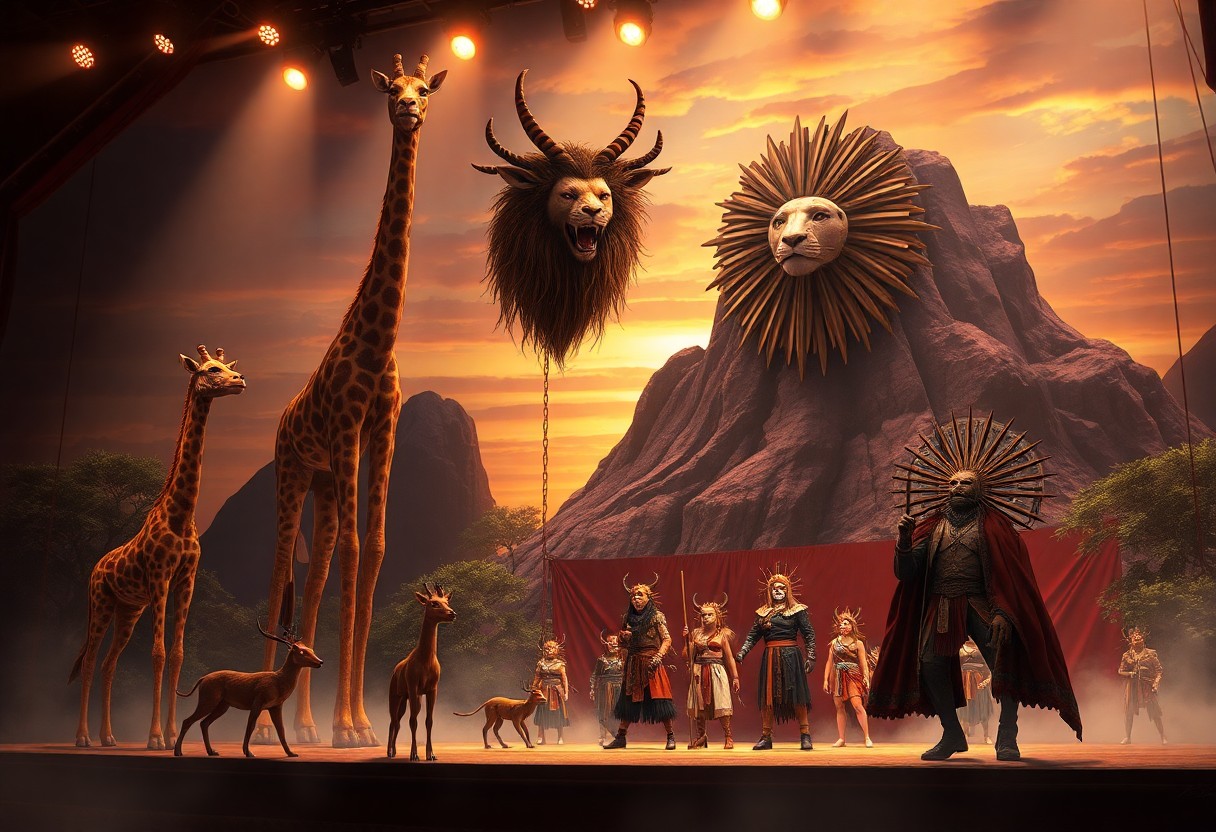
Musical theater reaches a record-breaking zenith with The Lion King, a stage production that has captivated over 110 million people across 100 cities. You experience not just a performance but a revolution in puppetry and costume design, where actors portray animals in full view, using ingenious mechanics to suggest rather than conceal movement. The show’s 95% recouped production cost on Broadway underscores its financial and cultural dominance.
Key Takeaways:
- The Lion King musical features over 150 handmade costumes and puppets, many inspired by traditional African art and tribal dress, with some headpieces weighing more than ten pounds to achieve authentic silhouettes of animals.
- Julie Taymor, the show’s director and costume designer, became the first woman to win a Tony Award for Best Direction of a Musical, a milestone achieved largely due to the show’s groundbreaking integration of shadow puppetry and actor movement to represent animals on stage.
- The production uses a technique called “double character” design, where actors perform alongside or within puppets, allowing audiences to see both the human performer and the animal character simultaneously, as seen in the portrayal of the giraffes and antelopes during the “I Just Can’t Wait to Be King” sequence.
Primary Types of Puppetry and Costume Design
Costumes and puppets in The Lion King merge African artistry with theatrical innovation. Performers wear shoulder-mounted puppets, hand-held animal figures, back-mounted frames, full-body suits, and face masks to embody creatures. Perceiving the performer’s movement as integral to the puppet’s life transforms static objects into breathing characters.
Sending money abroad?
Wise makes international transfers cheaper than most banks — real exchange rates, low fees, and a free debit card option in many countries.
Need social posts without the grind?
Holo turns one idea into reels and photo posts with AI — useful if you promote shows, reviews, or fan content and want more output with less editing time.
| Type | Function |
| Shoulder-mounted puppets | Allow actor’s face to remain visible while portraying animal heads |
| Hand-held animal figures | Used for smaller creatures like meerkats and birds |
| Back-mounted frames | Support giraffe and elephant silhouettes without obstructing motion |
| Full-body suits | Enable acrobatic movement while maintaining animal shape |
| Face masks | Partially conceal performers to suggest animal traits while preserving expression |
Julie Taymor’s Mask and Puppet Philosophy
Julie Taymor prioritizes the visibility of the performer’s eyes to maintain emotional connection. Her designs avoid full concealment, allowing audiences to see human and animal elements coexist. This duality reinforces the story’s spiritual themes and underscores the ensemble’s dual role as narrators and characters.
The Integration of Shadow Puppetry and Human Movement
Shadow puppetry outlines key narrative moments, such as Mufasa’s spirit in the stars. The silhouetted figures, manipulated behind translucent scrims, blend with dancers’ gestures. Perceiving the interplay between flat images and three-dimensional motion reveals how space and scale are redefined on stage.
Shadow sequences are choreographed in tandem with lighting cues to create depth, often projecting figures larger than life. A mid-sized SaaS firm might rely on scalable infrastructure, but here, scalability is achieved through movement and light. Puppeteers time their motions precisely with actor positioning so transitions between real and symbolic feel effortless, as when Zazu appears first as a cutout, then as a full puppet.
Critical Factors Influencing the Musical’s Longevity
- The authentic South African choral arrangements deepen cultural resonance
- Julie Taymor’s visionary direction redefined stage storytelling
- Coming-of-age narrative allows multi-generational audience connection
- Use of innovative puppetry creates unforgettable visual language
- Score retains iconic melodies while expanding orchestral depth
After more than two decades, the show still draws standing ovations in over 20 countries.
Authentic South African Choral Arrangements
You hear the distinctive harmonies of South African isicathamiya choirs in numbers like “Lioness Hunt”. Composed by Lebo M, these vocal textures ground the story in its geographic and cultural setting. The layered call-and-response patterns reflect traditions passed through generations. You feel the ancestral weight in every chant.
The Universal Appeal of the Coming-of-Age Narrative
You witness Simba’s journey from reckless cub to responsible king, a path familiar across cultures. The emotional arc mirrors rites of passage experienced by youth worldwide. After.
A mid-sized SaaS firm might track user growth over quarters, but Simba’s evolution spans years, loss, and return. You recognize the tension between duty and identity, a conflict as relevant to adolescents today as in ancient myth. The story refracts personal growth through a royal metaphor, making internal struggles visible and grand. After Shakespearean exile and redemption, the final scene crowns not just a lion, but the idea of maturity earned.
Pros and Cons of the Broadway Adaptation vs. Film
The stage version transforms animated magic into tangible spectacle, yet faces inherent constraints in translating cinematic scale. Your experience shifts from screen-based immersion to live theatrical innovation, where human performance and design ingenuity redefine storytelling. The following table outlines key comparative elements between the two mediums.
| Live orchestration | Enhances emotional depth with real-time musical dynamics |
| Actor-puppet integration | Allows nuanced physical performances unseen in animation |
| Costume artistry | Visible craftsmanship fosters deeper audience connection |
| Limited scene transitions | Slower set changes disrupt narrative momentum |
| Fixed camera angles absent | Audience chooses visual focus, risking missed details |
| Real-time vocal delivery | Enables subtle emotional shifts with each performance |
| Restricted aerial movement | Prevents full replication of Pride Rock panoramas |
| Immediate audience feedback | Actors adjust timing and delivery nightly |
| No digital effects | Reliance on practical solutions limits visual scope |
| Unique casting interpretations | Different actors bring fresh nuances to iconic roles |
Advantages of Physicality and Live Interaction
Seeing actors move in real time gives Simba’s journey a visceral immediacy. You feel the weight of Mufasa’s presence through vocal projection and stance, not just voiceover. The live pit orchestra underscores emotional beats with dynamic precision, and audience reactions become part of the performance, creating a shared energy no film can replicate.
Limitations of Recreating Vast African Landscapes
Stage design cannot fully capture the sweeping savannas shown in the film’s opening sequence. You rely on symbolic backdrops and lighting to suggest scale, losing the cinematic breadth of Pride Rock’s domain. The physical boundaries of the theater inherently constrain environmental realism.
Designers use layered silhouettes and shadow play to imply distance, but the illusion remains limited by proscenium dimensions. A mid-sized SaaS firm might scale globally with digital infrastructure, yet here, geography is bound by wood, paint, and light. The stampede sequence, while powerful, compresses space dramatically compared to the film’s wide-angle chaos, forcing creative abstraction over literal representation.
Step-by-Step Guide to the Pre-Show Transformation
Every performance begins long before the curtain rises, with a precise sequence turning actors into the iconic inhabitants of the Pride Lands. From prosthetics to puppetry, each element is applied in a specific order to ensure both character authenticity and performer safety.
| Stage | Action |
| 1 | Arrival and vocal warm-ups |
| 2 | Base layer costume fitting |
| 3 | Prosthetic application and adhesion |
| 4 | Full costume assembly |
| 5 | Final movement and technical checks |
The Rigorous Makeup and Prosthetic Ritual
Your transformation starts 90 minutes pre-show, when makeup artists apply lightweight foam latex prosthetics using medical-grade adhesive. Each piece must align perfectly with your facial structure to allow full expression and prevent irritation during extended wear.
Final Technical Calibration of Stage Mechanics
Technicians verify all moving set pieces, trapdoors, and puppet mechanisms function correctly moments before curtain. Your safety and the show’s pacing depend on these silent, split-second adjustments backstage.
Automated rigging systems controlling the giraffe procession and stampede sequence undergo real-time diagnostics, ensuring synchronized movement with the actors. A single misaligned cue could disrupt the illusion, so each motorized component is tested under stage load conditions, confirming reliability within a fraction of a second. These calibrations are non-negotiable, especially during rapid scene transitions involving elevated platforms and rolling set walls.
Essential Tips for an Enhanced Viewing Experience
Maximize your enjoyment of The Lion King musical by arriving early, familiarizing yourself with the theater layout, and reviewing the program notes. Focus on the puppetry, costume artistry, and musical motifs unique to the stage adaptation. Recognizing subtle details enhances emotional engagement and deepens appreciation for the production’s craftsmanship.
Strategic Seating for Optimal Visual Perspective
Choose seats in the orchestra or mid-level mezzanine to fully appreciate the stage depth and processional entrances. Avoid extreme side sections where sightlines may obscure choreography or puppet movement. Recognizing the spatial design ensures you witness every nuance of the performance.
Identifying Hidden Symbolism in the Set Design
Observe how the circular motifs in the set pieces and lighting gels reflect the Circle of Life theme. The use of layered silhouettes and shadow play during transitions subtly reinforces character journeys. Recognizing these elements reveals deeper narrative layers.
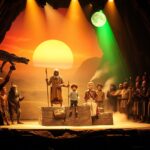
During the opening number, the rising sun aligns with a backdrop shaped like a traditional African shield, linking heritage to the story’s foundation. The baobab tree structure center stage transforms across acts, symbolizing both growth and decay. The color palette shifts from warm ochres to stark grays as Scar’s reign takes hold, mirroring moral collapse. Recognizing these deliberate choices underscores the production’s narrative precision.
Behind-the-Scenes Production Secrets
Designers integrated African tribal motifs with avant-garde stagecraft to create a visual language distinct from the animated film. The use of visible puppeteers was a deliberate choice to honor traditional African storytelling, transforming what some might see as a limitation into a powerful artistic statement. Each movement is choreographed with martial precision.
Engineering the Iconic Pride Rock Set Piece
A team of riggers operates a hydraulically powered lift system beneath the stage to raise Pride Rock during the opening number. The structure weighs over 1,500 pounds and ascends in exact synchronization with the ensemble’s choreography. Hidden counterweights ensure smooth, silent movement during the show’s most iconic moment.
Maintenance and Operation of High-Wear Animal Costumes
Costume technicians inspect each animal suit nightly for stress points, especially around articulated joints and puppet limbs. Replacement parts are pre-fabricated to minimize downtime, and quick-release fasteners allow for emergency repairs between scenes. Materials must withstand body heat, sweat, and constant motion.
During a performance run at a major international venue, one hyena costume required over 30 hours of maintenance weekly due to its complex head mechanism. Technicians use industrial-grade adhesives and breathable mesh linings to balance durability with performer safety. Each major animal costume has a dedicated handler throughout the show.
To wrap up
You experience over 200 puppets and masks during a single performance of The Lion King musical, each crafted to reflect specific animal movements and African artistry, while performers often manipulate multiple pieces in real time, such as the giraffe puppet operated by three actors simultaneously, blending choreography and engineering in ways unseen in the original film.
FAQ
Q: How long did it take to develop the puppetry and costume designs for Disney’s The Lion King musical?
A: The development of the puppetry and costume designs spanned over two years, led by Julie Taymor in collaboration with Michael Curry. This period included extensive research, prototyping, and workshops to refine the animal-inspired masks and wearable sculptures. Performers in the production often manipulate multiple puppet elements simultaneously, such as the giraffe, which requires two actors to operate its head and legs in unison, showcasing the complexity built into each design.
Q: Has The Lion King musical won any major awards for its technical achievements?
A: The original Broadway production earned six Tony Awards in 1998, including Best Costume Design and Best Direction of a Musical for Julie Taymor, who became the first woman to win in the latter category. The show’s innovative use of shadow puppetry, particularly during the “Circle of Life” opening sequence, set a new benchmark for visual storytelling on stage and has been widely studied in theater design programs.
Q: Are any performers from the original 1997 production still involved in current casts worldwide?
A: While no original Broadway cast members remain in the New York production, several performers from early international stagings continue to appear in regional or touring versions. For example, a performer who originated the role of adult Nala in the Australian premiere later joined the London West End cast, maintaining a direct lineage to the show’s earliest interpretations. The global network of productions has allowed some performers to transition across continents within the same role over decades.
Curious about forex — without risking real money first?
XM offers a free demo account so you can practice trading with virtual funds before deciding whether live trading is for you.