
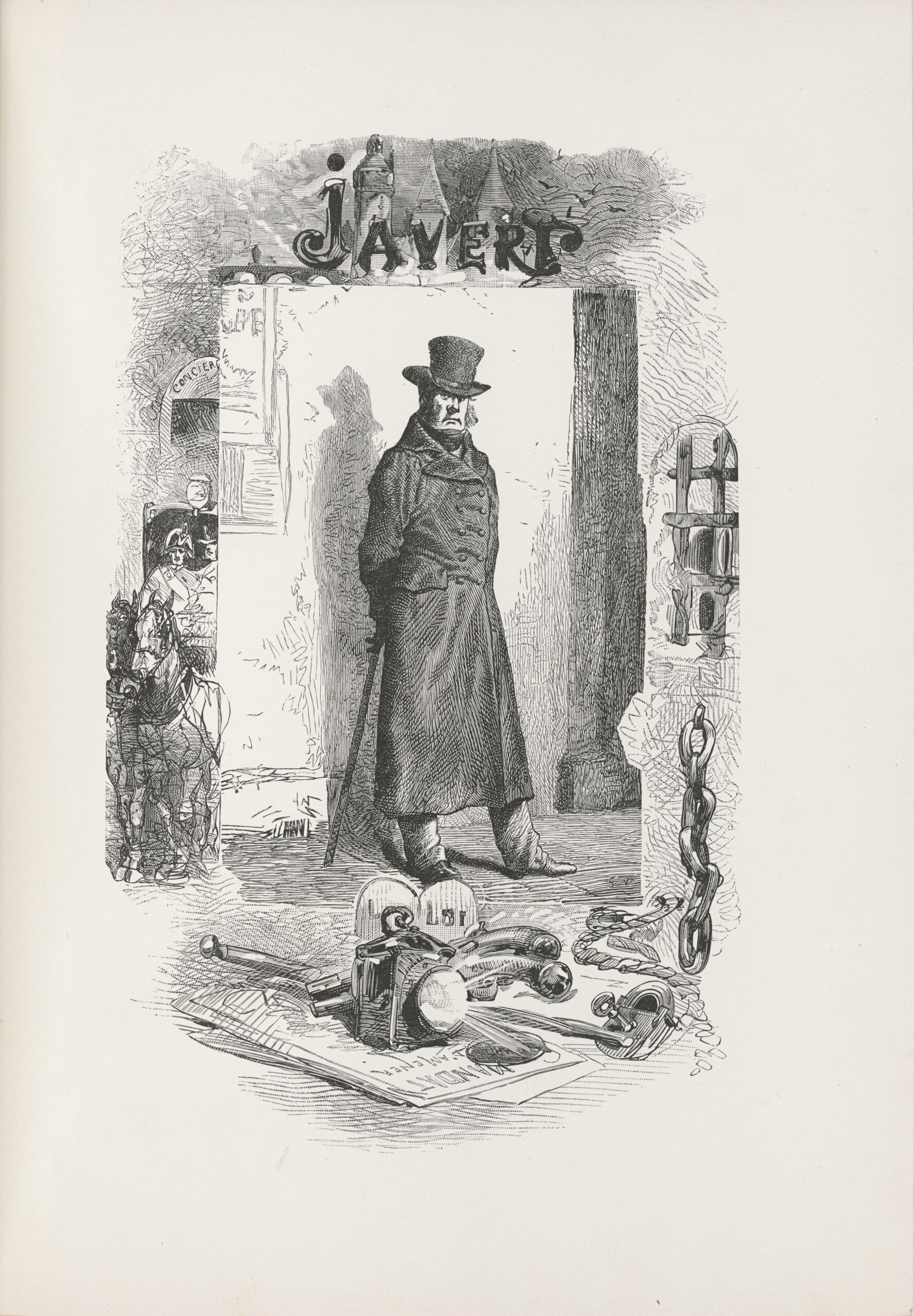
Javert is the police inspector in Les Misérables who spends almost two decades hunting Jean Valjean, the ex-convict once known as Prisoner 24601. He is not a crook or a sadist. He is a man who believes the law is always right and that a criminal can never change, and the whole story is built to break that belief. Here is who Javert is in Victor Hugo’s novel and in the musical, why he will not let Valjean go, the songs that define him, and the actors who have played him from London to Broadway to the 2012 movie.
By the Musicals On Line team · November 2026
Who is Javert in Les Misérables?
In Hugo’s 1862 novel, Javert is the “morally strict police inspector” who pursues Valjean “relentlessly,” as Britannica puts it. In the musical by Claude-Michel Schönberg and Alain Boublil, he is the first authority figure we meet: the guard who releases Valjean on parole in 1815 after 19 years of hard labor, then the inspector who keeps turning up wherever Valjean tries to start over (Wikipedia, MTI synopsis).
He is Valjean’s mirror image. Valjean is a convict who becomes a good man through one act of mercy; Javert is an officer who cannot accept that such a change is possible. Our Les Misérables characters explained guide shows where he fits among the rest of the cast.
Why does Javert hunt Prisoner 24601?
Because Valjean broke his parole. After the Bishop of Digne’s kindness, Valjean tears up his papers, takes a new name and starts a new life, and to Javert that makes him a fugitive for life (Wikipedia, MTI). In the Prologue, Javert knows him only by his number. For the full story of the number, the parole scene and what 24601 might mean, read our guide to Prisoner 24601 in Les Misérables.
It is never personal hatred. In the novel, Hugo says Javert is built on two sentiments, “respect for authority, hatred of rebellion,” and that “in his eyes, murder, robbery, all crimes, are only forms of rebellion” (Project Gutenberg text, Wikipedia). A man who has escaped the law once is, for Javert, lost for good.
Javert’s backstory in the novel
- Born in prison. Hugo writes that Javert “had been born in prison, of a fortune-teller, whose husband was in the galleys.” Shut out from respectable society, he chose the side that guards it and joined the police (Gutenberg, Wikipedia).
- A guard at Toulon. Before becoming an inspector, he worked in the convict prisons of southern France and was an adjutant-guard at Toulon, where he first saw Valjean (Gutenberg, Wikipedia).
- No exceptions. Hugo says he “would have arrested his own father” had the man escaped from the galleys (Gutenberg, Wikipedia).
- A real-life model. Hugo sums him up as “a marble informer, Brutus in Vidocq,” a nod to Eugène François Vidocq, the convict who became chief of the Paris Sûreté. Vidocq is widely cited as an inspiration for both Javert and Valjean (Gutenberg, Wikipedia: Vidocq, Wikipedia: Javert).
Javert’s key scenes, from Montreuil-sur-Mer to the Seine
- The runaway cart. When the mayor of Montreuil-sur-Mer, “Monsieur Madeleine,” lifts a cart off a trapped man, Javert recognizes the strength of a convict he once knew and suspects who the mayor really is (Wikipedia, MTI).
- The wrong man. In the novel, Javert believes another man, Champmathieu, has been arrested as Valjean, and he asks the mayor to have him dismissed for his false suspicion. Valjean clears Champmathieu by confessing in court (Gutenberg, Wikipedia). The musical keeps the trial in Valjean’s “Who Am I?”
- Fantine’s bedside. Javert arrests Fantine, then comes for Valjean as she is dying; Valjean escapes to keep his promise to raise Cosette (Wikipedia, MTI).
- The barricade. Javert slips into the students’ barricade as a spy and is unmasked by the street boy Gavroche. Valjean is given the job of executing him and lets him go instead (Wikipedia, MTI, London Theatre).
- The sewer exit. Javert finds Valjean carrying the wounded Marius out of the sewers and, against everything he believes, lets him take Marius home (Wikipedia, MTI).
- The Seine. Unable to square Valjean’s mercy with his own view of justice, Javert throws himself into the river. Hugo titles the chapter “Javert Derailed” (Gutenberg, Wikipedia, MTI).
For the whole plot in order, see the complete story of Les Misérables explained.
Javert’s songs in the musical
Javert has fewer solos than Valjean, but they are some of the most quoted moments in the score. These are the numbers listed for him in the original Broadway production on IBDB and in the musical’s synopsis on Wikipedia:
| Song | What happens |
|---|---|
| Prologue: “Work Song” (Look Down) | Javert, then a prison guard, releases Prisoner 24601 on parole. |
| “The Confrontation” | Javert and Valjean sing over each other at Fantine’s deathbed, one demanding an arrest, one begging for time. |
| “Stars” | Javert’s Act One solo, a prayer-like vow to bring Valjean to justice. |
| “Javert at the Barricade” / “Little People” | The spy is caught, unmasked by Gavroche. |
| “Soliloquy” (Javert’s Suicide) | Freed by Valjean, Javert cannot live in a world where mercy beats the law. |
“Stars” is the song that turns him from villain into tragic figure: London Theatre calls it the moment he explains “his personal faith and how it shapes his profession,” and BroadwayWorld names it his standout number. We walk through every number in Les Misérables songs explained, and you can read the words to the finale in our page on Javert’s Suicide.
Book vs. musical: how Javert changes
The musical keeps Javert’s arc almost exactly, but it trims his backstory. The prison birth, the fortune-teller mother and the Toulon years appear only in the book. It also makes him a richer character on stage: Hugo gives us his inner life mostly in the final chapter, while the musical hands him “Stars” in Act One, so audiences understand his faith long before it breaks (Gutenberg, London Theatre, Wikipedia). If you want the novel’s view of the character, start with his introduction in Part One, Book Fifth (“The Descent”), and his last night in Part Five, Book Fourth (“Javert Derailed”).
Who has played Javert?
Here are the landmark performances, each confirmed by at least two sources:
| Production | Javert | Sources |
|---|---|---|
| Original London production, RSC at the Barbican (1985) | Roger Allam | RSC collections, Roger Allam official site, Wikipedia |
| Original Broadway production (1987) | Terrence Mann | Playbill, IBDB, BroadwayWorld |
| 10th Anniversary Concert, Royal Albert Hall (1995) | Philip Quast | Cameron Mackintosh, Wikipedia |
| First Broadway revival (2006) | Norm Lewis | BroadwayWorld, Wikipedia |
| 25th Anniversary Concert, The O2, London (2010) | Norm Lewis | Playbill, PBS |
| Movie musical, dir. Tom Hooper (2012) | Russell Crowe | Britannica, Variety, Vanity Fair |
| Second Broadway revival (2014) | Will Swenson | BroadwayWorld, Wikipedia |
Other Broadway Javerts over the original run included Robert Cuccioli and Shuler Hensley (BroadwayWorld, IBDB). Norm Lewis’s O2 concert aired on PBS in the US, so for many American fans he is the Javert they know best (Playbill, PBS).
Crowe sang his performance live on set: the cast wore hidden earpieces and followed a pianist playing live, and the orchestra was added later (Variety, Vanity Fair). Before the musical, Javert was played on screen by Charles Laughton (1935) and Geoffrey Rush (1998), among others (Britannica, Wikipedia).
To hear Philip Quast’s Javert, the full 10th anniversary concert is available on DVD: check price on Amazon. (Affiliate link: as an Amazon Associate, Musicals On Line earns from qualifying purchases at no extra cost to you.) Our guide to the 10th anniversary concert cast covers everyone else on that stage.
Is Javert a villain?
He is the antagonist, but not a villain in the usual sense. He never lies, never takes a bribe and never acts for himself; he simply believes the law and justice are the same thing. That is why his ending lands so hard. When Valjean, the criminal, shows him mercy, Javert has no way to fit it into his world, and his certainty collapses (Wikipedia, London Theatre). If that kind of story is your favorite part of Les Mis, our list of musicals like Les Misérables has more shows built on the same big moral clashes, and the Les Misérables complete fan guide collects everything else.
Frequently asked questions
Who is Javert in Les Misérables?
Javert is the police inspector who hunts Jean Valjean, the ex-convict known as Prisoner 24601, for breaking his parole. He believes the law is always right and that criminals can never change.
Why does Javert chase Jean Valjean?
Valjean broke his parole and took a new identity. To Javert, that makes him a fugitive forever, no matter how many good deeds he does as Monsieur Madeleine.
What songs does Javert sing in Les Misérables?
His main numbers are the Prologue (Work Song), The Confrontation, Stars, Javert at the Barricade and his Soliloquy, also called Javert’s Suicide.
How does Javert die?
After Valjean spares his life at the barricade, Javert lets Valjean go at the sewer exit, then throws himself into the Seine because he cannot reconcile mercy with his idea of justice.
Who played Javert on Broadway?
Terrence Mann created the role on Broadway in 1987. Later Broadway Javerts include Robert Cuccioli, Shuler Hensley, Norm Lewis in the 2006 revival and Will Swenson in the 2014 revival.
Sources: Victor Hugo, Les Misérables (Project Gutenberg); Britannica; MTI full synopsis; London Theatre; IBDB; Playbill: original Broadway; BroadwayWorld; RSC performance collections; Roger Allam official site; Cameron Mackintosh; Playbill: 25th anniversary on PBS; PBS; Variety; Vanity Fair; Wikipedia: the musical; Wikipedia: Javert; Wikipedia: Vidocq.